

Northwest Arkansas: 622,177
St. Louis, MO: 2,814,421
Boston, MA: 5,034,221
The Northwest Arkansas metropolitan area is 4.5x smaller than the St. Louis metropolitan area and 8x smaller than the Boston metropolitan area.
St. Louis held onto Panera Bread Company (founded in 1987 as “St. Louis Bread Company” or as locals refer to it “Bread Co.”) for 40 years. Last month, Paul Carbone, Panera’s recently installed CEO, announced a move of the company’s headquarters to Boston by July 2027.
Bentonville, five hours southwest in neighboring Arkansas, has kept Walmart’s HQ since the 1970s, with no signs of impending abandonment.
What gives?
Panera announced Mr. Carbone as the new CEO in March 2025 after he’d spent two months as interim CEO. Prior to assuming the top job, he’d been Panera’s CFO since August 2023. A Massachusetts native and former CFO of Dunkin’ Brands, Mr. Carbone worked primarily out of the Newton, MA corporate support center.
Likewise, many other Panera C-suite executives appeared to live and work in cities other than St. Louis: Miami, Atlanta, more Boston.
Like many large corporations, the chief executives of Panera are highly compensated, mobile, and remote (or at least hybrid) relative to the official headquarters in the St. Louis metro area.
But the rest of Panera’s non-restaurant employees? Primarily St. Louis. Over 650 of them. More live elsewhere and work remote. Many of them now face a choice: relocate to Boston or take voluntary severance?
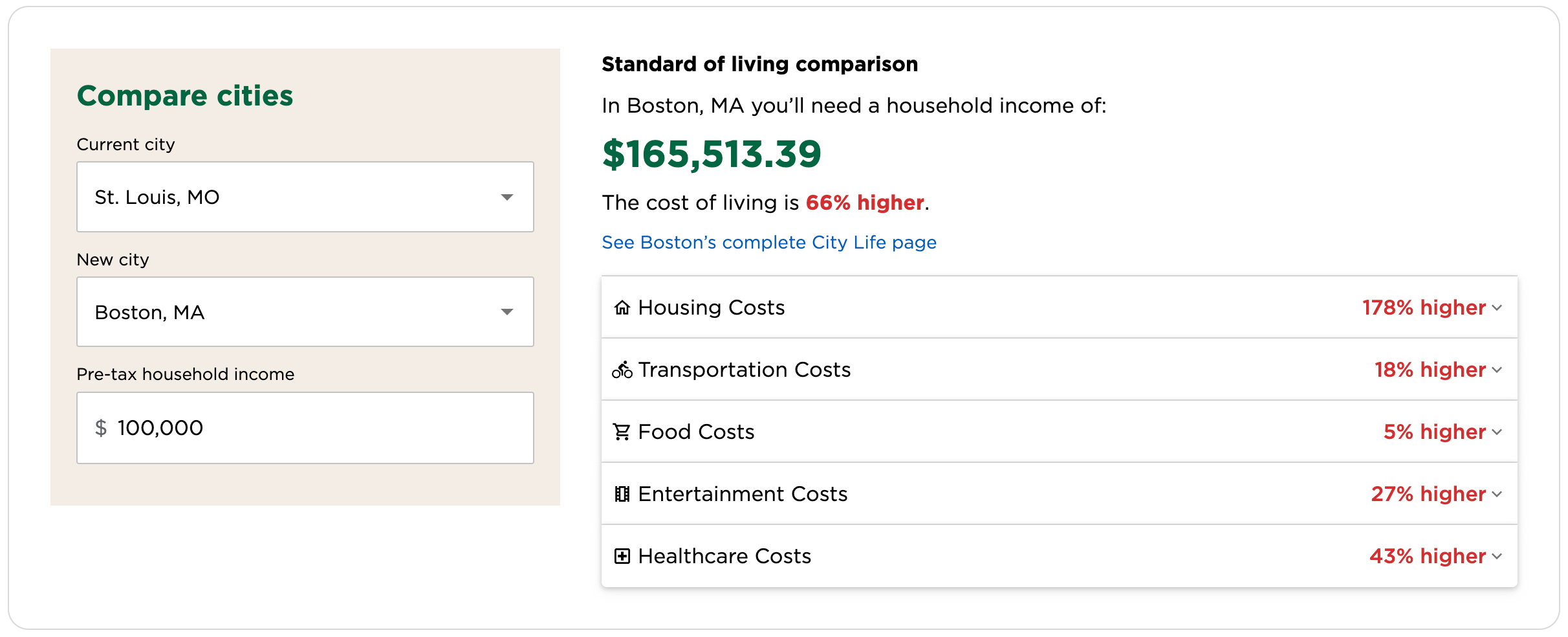
For most, moving comes with a 10% salary increase. For some, an additional relocation allowance up to $50,000. For all, an insanely higher cost of living. According to NerdWallet (who uses cost of living data from the Council for Community and Economic Research), living in Boston is 66% more expensive than in St. Louis. (Housing alone is 178% higher!)
So why move HQ from its traditional home of St. Louis for the Boston area?
Before moving on further, I need to confess something:
I’m not an unbiased observer. I want to understand Panera’s move, but I’m not Mr. Spock, largely keeping my emotions in check and operating by pure logic.
As a Peoria area native, I’m heavily influenced by April 19, 2017, the day Caterpillar announced it’d be moving of its global headquarters from Peoria to Chicago. (Technically, CAT moved to Deerfield, IL, a northern suburb of Chicago. Like how I say Panera is moving to Boston from St. Louis when the firm is technically moving HQ from Fenton, MO to Weston, MA, I often refer to the metropolitan area.)
CAT’s official reason? To be closer to a major airport: O’Hare.
(Side note. O’Hare will get you more places. Correct. But the TSA line at the Peoria International Airport is nonexistent. You never need pre-check. And it takes less than half-an-hour of in-air flight to get to Chicago. Plus, parking in Peoria is free! Take that, O’Hare.)

No one in my family worked for CAT. My parents taught college business at Bradley University, so many of their students took jobs there after graduation. And many, many of my friends, classmates, and neighbors had parents who worked for CAT, either on the corporate side or at one of the two factories in the Peoria area. Nearly everyone in the area had some connection to the company; CAT’s employees supported all the local service jobs: teachers at schools, doctors and nurses at the three Peoria hospitals, owners and servers at any area restaurant. (Peoria is a company town, and CAT served as an employment multiplier.)
CAT expected 100 employees to relocate from Peoria to Chicago, eventually having 300 in the new Deerfield HQ with most remaining in Central Illinois.
As it’s been nearly a decade since that announcement, how has it played out? It’s a slow trickle away. Many CAT employees remain in Peoria, but look at the CAT job board. What types of jobs can you get and where? Nashville is a popular location. But also, Irving, TX? Oh right. CAT later moved its global HQ again in 2022. The trip to O’Hare must have been taking too long. A drive from the new-new-HQ to DFW now takes half the time (saving 10 minutes each way)!
If we check back in another ten years, I wonder how many CAT employees will remain in Peoria, whether or not the plants will still be in Mossville and East Peoria, and if CAT’s latest headquarters will simply be in an airport. With the current price of jet fuel, some airport somewhere may consolidate flights further and think “Becoming a landlord is a valuable use of Terminal 4, right? (It’s a prime location right next to Cinnabon!)”
Less speculation about Cinnabon-adjacent headquarters. More facts about Panera Bread Co.
What justification has Panera given for its move to Boston?
According to Paul Carbone, "We understand this [moving to Boston] is a significant change, but one that is necessary to drive forward our RISE strategy that will lead us into the future."
And what exactly is Panera’s RISE strategy? See below.

What does RISE mean operationally? It’s a menu with new additions (plus the removal of iceberg lettuce in favor of OG romaine), the addition of a “Guest Experience Champion" to improve the front-of-house greeting, and an overall focus on the experience. After years of declining sales related to fewer patrons entering, not necessarily due to patrons ordering less food or choosing lower cost options, Panera needed to make some changes, certainly. (Being a firm privately held by the European conglomerate JAB Holding with attempted public offerings in 2021 and 2023 only adds to the financial turnaround pressure. Similar pressure would exist for a public firm.)
Carbone also noted moving most corporate employees from St. Louis to Boston would allow for “deeper collaboration, faster decision-making, and a more unified culture.” Plenty of people debate the merits of in person work vs. remote or hybrid work. But for the most part, Panera has already answered that question: employees are mainly in person. If Panera wanted everyone in person to improve collaboration, decision-making, and culture, then the company could require its remote workers to move to St. Louis, not Boston.
Carbone and other high level executives may have remained hybrid or remote from most employees, like the executives of Caterpillar currently do relative to most Peoria-based employees. Or, if they felt having all employees (including C-suite executives) in one place would make a large change, they all could also move to St. Louis full time.
The primary question Panera faced when deciding who should move is this: Will the gains of moving all corporate employees outweigh the losses? (Because there are always tradeoffs…)
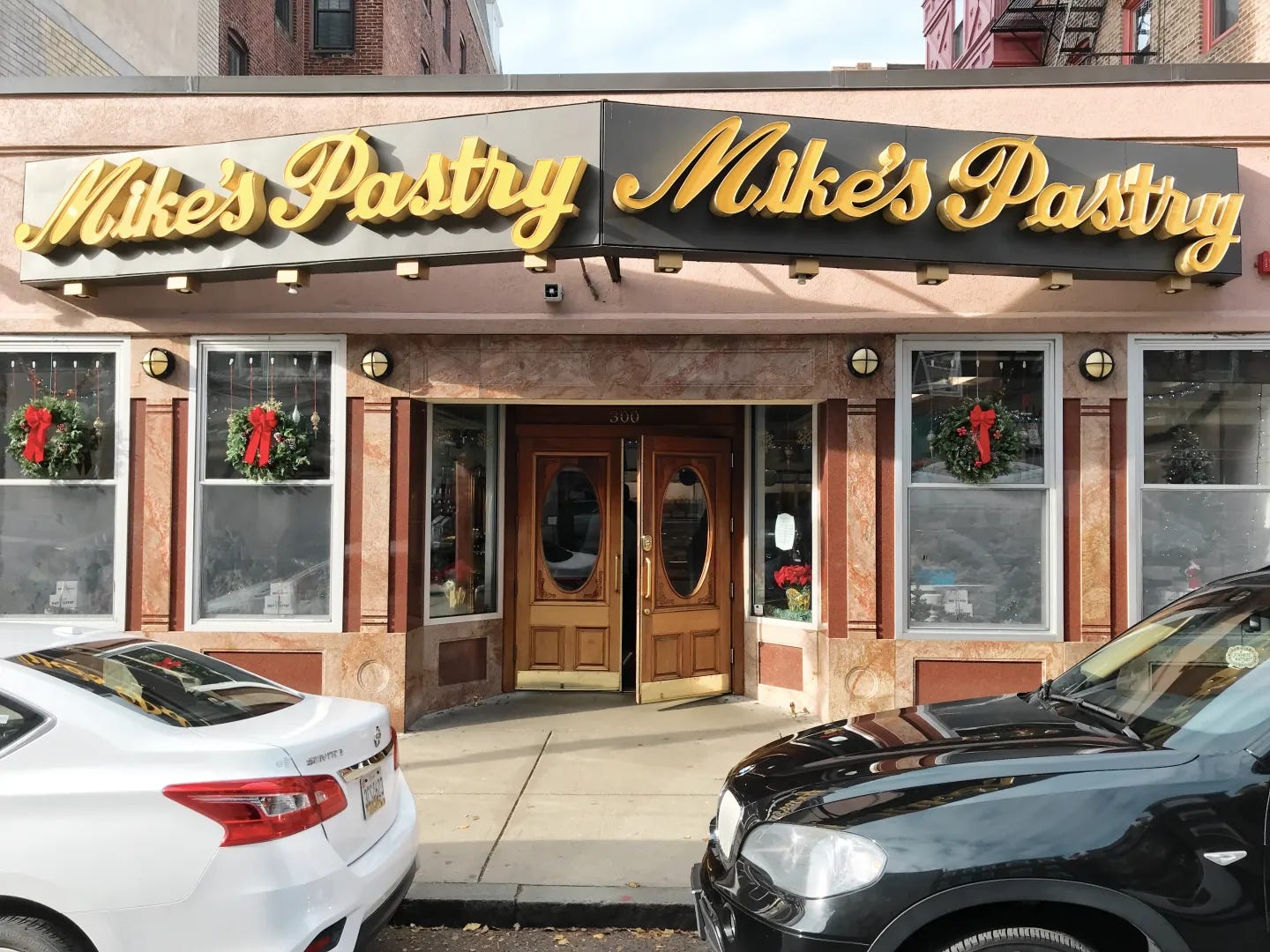
Boston has its upsides, don’t get me wrong. (And I’m not only talking about the cannoli at Mike’s in the North End. But those are very good, highly recommend.)
Boston’s more a “hub city” for professionals and executives than is St. Louis. More companies from a variety of industries have their headquarters there. This makes for a nimble, more fluid recruitment market as more executives already live and work in the area. An Executive VP of Strategic Finance could easily move up to become another company’s CFO without asking a spouse to move or uprooting middle school aged kids. Simply put, more candidates are local. Actually finding alpha and hiring the higher quality executive depends on the skill of the firm.
Tradeoff #1? Your current executives also have more opportunities to easily leave for an upward (or lateral) move. In three years, that Executive VP who became your CFO could easily become your competitor’s CEO without ever moving school districts.
Tradeoff #2? Moving most of your corporate employees to Boston from St. Louis to take advantage of the greater web of local executives results in a loss of human capital on the non-executive level. It’s inevitable. The cost of living differences mentioned before are astronomical; a CFO may not personally notice, but the entry level accountant will. Plus, some employees are rooted in St. Louis for more personal reasons: they have extended family living close by, their kids are at a bad age for a disruptive move, they have Cardinals season tickets and just can’t imagine becoming Red Sox fans. Ultimately, many current employees will remain in St. Louis and will look for other jobs. Yes, Boston has enough people Panera will find replacement accountants, financial analysts, and HR representatives (all requiring ongoing higher wages and benefits to reflect Boston’s increased cost of living). But Panera will also lose institutional knowledge when long time employees remain in St. Louis.
Academic research quantifies those tradeoffs: 167 corporations who moved their headquarters demonstrated “little evidence of improved operating performance after headquarters relocation.” A study published in 2026 examined 9,952 public firms across 127 cities and found the headquarters’ specific cities accounted for 1.52% of the total variance in corporate performance. Differences at the firm level (including human capital but also factors such as firm strategy, IP, financial structure, etc.) was the strongest factor driving variation in performance, accounting for 20.34%.
While both statistically significant drivers in a firm’s performance, what’s internal to the firm matters much, much more on average than where HQ is.
But that’s “on average.” Panera has a good argument for moving everyone from St. Louis to Boston if it believes its unique circumstances mean the benefits of existing within a larger network of local executives will outweigh the costs of lost human capital, higher ongoing labor expenditures, and the inevitable disruptions to daily operations while moving and hiring replacement employees.
Perhaps Panera believes such a move is a necessary type of “organizational reset”? Losing current employees and causing day-to-day friction while replacing them may create short term friction, but long term? Historic, suboptimal processes may give way to streamlined operations. Not everything a firm currently does is the correct way to continue from now until forever, and a large move allows for a reset. (But then again, new ways of working may also be inefficient or straight up wrong.)
Which brings us back to Northwest Arkansas. Population: 622,177.
And to Bentonville, the long-time home of Walmart, Inc.
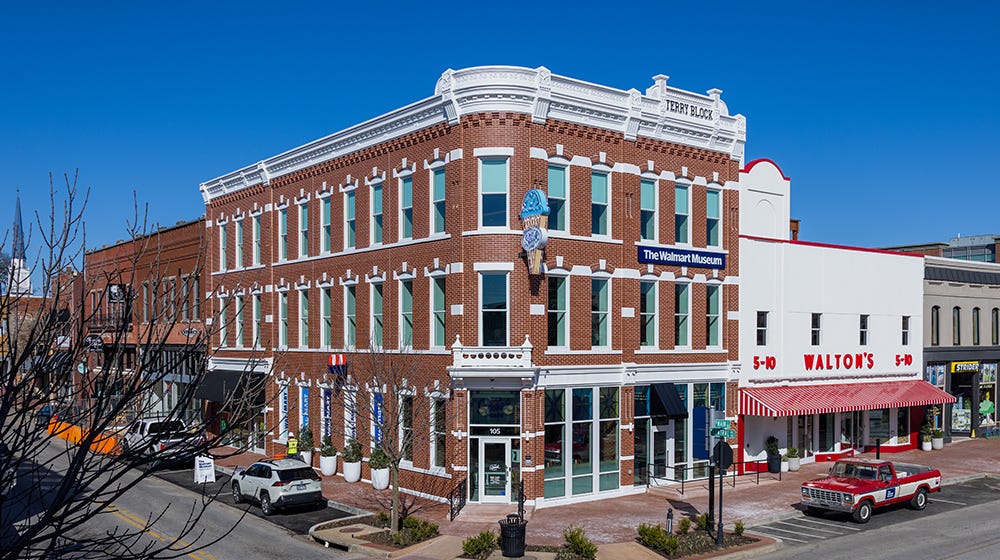
Sam Walton opened Walton’s 5&10 on the Bentonville square in 1950 (see above), unaware of how his company would grow and grow and grow. Walmart opened its first home office in 1971 before being listed on the NYSE in 1972.
And Walmart has been there ever since, expanding into a 350-acre corporate campus with over 15,000 corporate employees (and countless other employees from key Walmart suppliers close by).

But how? Northwest Arkansas faces more limitations than St. Louis, MO, nevermind Chicago or Boston. Fewer people live in and around Bentonville. Those who do are often connected to Walmart already. And those who don’t? I doubt Bentonville (or the state of Arkansas more generally) organically makes anyone’s list of “Top 100 Places I Dream of Moving To”?
Walmart understands these limitations and succeeds because it finds ways to neutralize them. The company creates a culture of growth, specifically noting: “[Our] people are our greatest competitive advantage. These internal promotions reflect our culture of opportunity and the depth of our leadership bench.” Junior level employees see chances for advancement, to work their way up-the-ladder in a world where job tenure feels shorter and shorter with each passing year. But that’s not to say all employees, at any level, remain at Walmart their entire careers. Some executives depart for good. Others leave for a move upward elsewhere, only to later return to Walmart.
For executives who join from elsewhere, Walmart frequently asks them to move to Arkansas. It brings the executives to the institution, not the other way around. Some choose not to accept, either when initially approached about a job or when their role can no longer be fully remote. Being a Fortune 100 company with dwarf planet level gravitational pull, an advantage newer or smaller firms lack, certainly helps in recruiting at all levels, but some friction due to location remains. It just does not outweigh the other benefits to remaining in Bentonville: preserved institutional knowledge, lower labor costs, maintaining an ecosystem decades in the making.
A majority of firms on the 2026 Fortune 500 list congregate together. But a good sized minority choose to remain elsewhere. Headquarters for the 500 companies are spread amongst 39 states and the District of Columbia.
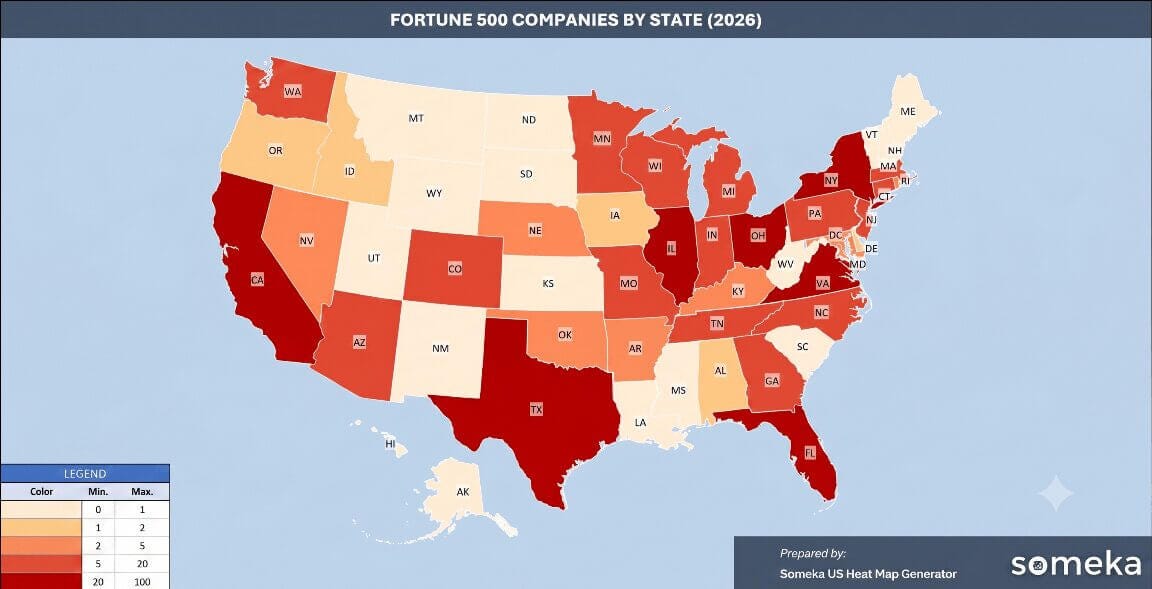
Narrowing further to the Fortune 100, Walmart Inc is not alone in choosing a hub off the beaten path:
Berkshire Hathaway - Omaha, NE
Eli Lilly - Indianapolis, IN
Procter & Gamble - Cincinnati, OH
State Farm - Bloomington, IL
Humana - Louisville, KY
FedEx - Memphis, TN
And falling just outside that top 100 is John Deere of Moline, IL. (Let me tell you, if Peoria isn’t a global hub, then Moline definitely is not.)
While not the majority, numerous top public firms remain in non-major executive hubs. They clearly continue to surmount geographic barriers and remain competitive.
So where does that leave us? Or more importantly, where does it leave Panera?
Relocating your traditional corporate headquarters is no surefire guarantee of success. The burden of proof should be on moving, not on remaining.
Could Panera have captured the advantages of Boston without moving nearly all other employees out of St. Louis?
It’s difficult to become Walmart overnight, not only in terms of sheer market influence but also in terms of an internal promotions culture. But you can require executives to move to the institution, not the other way around.
Creating a more portable headquarters, like Caterpillar, while leaving the majority of the workforce in the historic home remains an alternative if suitable executives are unwilling to relocate to St. Louis.
But, Panera did the calculus required to make a “Stay” or “Go” decision. It chose “Go” and “organizational reset.”
Time will tell if it would have been better to remain “St. Louis Bread Company.”